

BLOG
Canola production in South Africa may reach a fresh high in 2026-27
Many agricultural crops and value chains have shown dramatic progress in recent years. They should serve as an inspiration for further growth of this sector.
I often write about South Africa's soybean success story, whose production increased from 67,700 tonnes in the 1993-94 production season to an expected record harvest of 2,8 million tonnes in 2025-26. This, in turn, has been driven by increased demand for high-protein foods, particularly poultry products.
But soybeans aren't the only success story in South Africa's vegetable oils cluster.
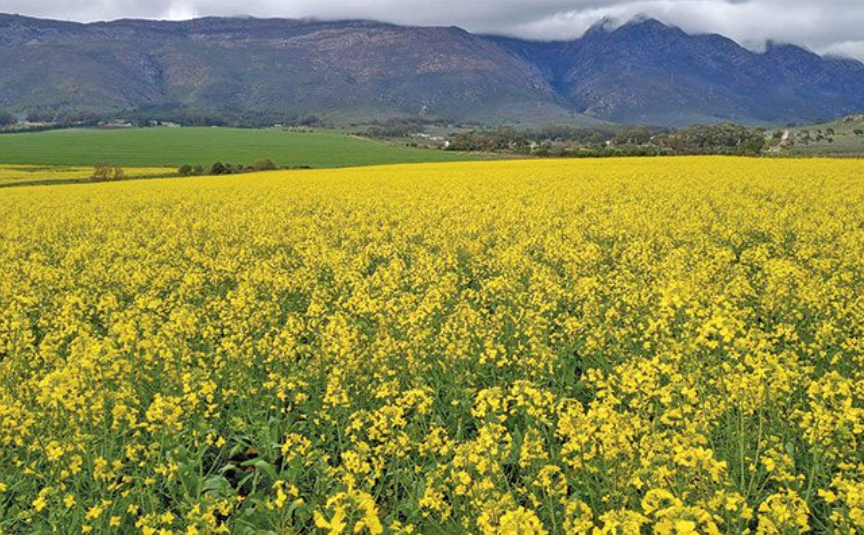
Canola is one of South Africa's agricultural success stories. Since South African farmers began commercial planting of the crop on 17,000 hectares in 1998-99, the area has increased to an estimated 174,515 hectares in 2025-26. For the 2026-27 season, the farmers plan to increase the area to 189,175 hectares.
Like soybeans, the catalyst behind the increase in canola plantings, among other things, is a rise in domestic demand or usage for oils and oilcake. There has also been a switch in some areas from wheat to canola due to higher profitability in recent times. South Africa is now a net canola exporter, having shipped to countries such as Germany and Belgium in recent years.
Canola is a winter crop. Hence, production is primarily in the Western Cape, a winter-rainfall region in South Africa.
Considering the farmers' intentions to plant 189,175 hectares, up by 8% from the previous season. If we assume relatively favourable weather conditions and a decent yield, applying a five-year average yield of 1,89 tonnes per hectare, South Africa could harvest 357,541 tonnes, up 16% from the previous season. This could be a fresh high.
Admittedly, it is still too early to tell with certainty where the canola crop harvest will be and whether farmers will successfully plant the area they intend to till. The key determinant will be the weather conditions, amongst other things.
Placing the current weather forecasts aside, I think it's fair to say that canola is one of the success stories of South Africa's agriculture, alongside the soybean industry and many of our fruits. The objective going forward is to see not only increases in various commodities, such as canola, but also a general improvement in agriculture across other areas of the country that haven't been part of the South African agricultural success story, such as the former homelands.
But for that to materialise, we need coordinated support and effective collaboration between the government and business. The government will need to do its part to improve land governance (release the government-owned land of 2.5 million hectares with title deeds), while leaning on commodity associations to support unlocking the agricultural value of regions that have been at the periphery of South Africa's agricultural success story.
This is an important step, not only for crops and fruits, but also for livestock and the poultry industries, which are already key value chains with greater participation by participants in the former homelands regions of South Africa. Again, as I have said several times, the effort realizing this ambition does not require new planting. We already have the Agriculture and Agro-processing Master Plan (AAMP), which is broadly embraced by agricultural stakeholders and other social partners and was co-created by all of them.
The AAMP seeks to improve South Africa's agriculture by unlocking various hindrances in key value chains and takes a commodity-specific approach. Importantly, the AAMP is also clear on what value chains could thrive in various regions. What is left now is for it to be fully implemented.
My book, "A Country of Two Agricultures", also advances this ambition, and clearly states the policy approaches South Africa must nudge to drive progress in the sector.
-Wandile Sihlobo is the chief economist of the Agricultural Business Chamber of South Africa (Agbiz).
0 COMMENTS
LEAVE A COMMENT