

BLOG
Tough environment for South African maize farmers
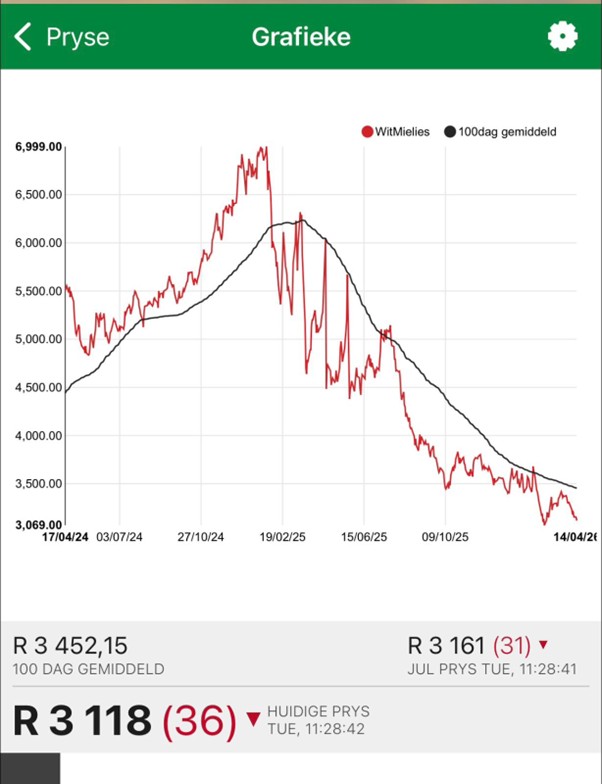
This is understandably not an uplifting picture for South African farmers to see. It shows that white maize spot prices in the country are down 39% from a year ago, trading around R3,118 per tonne.
Among other things, South Africa had a large maize harvest in the 2024-25 production season, but exports were slow in the marketing year that corresponded to this production year.
In essence, we have ample supplies. The outlook for the 2025-26 production season, which we are in, also looks promising, with an expected harvest of 16.5 million tonnes, down 1% from the previous season but well above the long-term average.
Importantly, this expected harvest is well above South Africa’s annual maize usage of 12.0 million tonnes. The 1% expected annual decline in the harvest is due to lower yields in some regions, despite higher plantings than in the previous season.
About 8.8 million tonnes of white maize, with 7.7 million tonnes being yellow maize. Such a maize crop, combined with likely large carryover stocks from the current season, signals that South Africa will yet again remain a net exporter of maize in the 2026-27 marketing year that begins in May (this corresponds with the 2025-26 production season).
This is important context for the near-term food price inflation viewpoint. We face higher fuel prices, but various agricultural input costs are under pressure, which, at least in the near term, helps lessen, to some extent, the surge in product prices resulting from higher energy costs. The ample supplies are not limited to maize; they include other products as well.
But from a farmer's perspective, this is a challenge. Unlike in 2022, when, at the start of the Russia-Ukraine war, higher energy and fertilizer prices were accompanied by rising grain prices, helping farmers to an extent, we now face a surge in input costs while commodity prices are under pressure.
The farmers are, and some will soon be under financial strain. Even more worrying is that we will soon be heading into the 2026-27 production season with likely higher input costs and a possible El Niño drought. If commodity prices are like this, one has to wonder what planting decisions farmers will make. The environment looks immensely challenging.
So, while the near-term picture for consumers remains comforting, there may be trouble along the way, induced by these challenges that will soon confront farmers. We are essentially at a time of immense uncertainty.
--Wandile Sihlobo is the chief economist of the Agricultural Business Chamber of South Africa (Agbiz)
0 COMMENTS
LEAVE A COMMENT